
SemGenAge 2025: 1st Workshop on Semantic Generative Agents on the Web
2 June 2025 in Portorož, Slovenia, as an official part of the Extended Semantic Web Conference ESWC 2025.
Workshop programme · Accepted papers · Programme committee · Organising committee · Proceedings (CEUR-WS Vol-3977)
A quarter of a century ago Berners-Lee originally expressed his vision of the Semantic Web as follows:
“I have a dream for the Web [in which computers] become capable of analyzing all the data on the Web – the content, links, and transactions between people and computers. A “Semantic Web”, which makes this possible, has yet to emerge, but when it does, the day-to-day mechanisms of trade, bureaucracy and our daily lives will be handled by machines talking to machines. The “intelligent agents” people have touted for ages will finally materialize.”
Nowadays, Large Language Models (LLMs) have materialised and are seemingly providing such “intelligent agents” capabilities: they are software systems that can perceive their environment through language and act by generating language with some level of autonomy. With respect to the internet they are able to analyse data on the web, including communication between people and computers, and they are able to talk to both other machines and humans.
Technologically the original vision of agents was based on symbolic knowledge representations (like RDF, OWL), agents with planning and deductive reasoning capabilities and symbolic agent communication languages (like FIPA-ACL) for multi-agent interactions and web service calls (like WSDL and WSCL). This is in stark contrast to how LLMs achieve those capabilities: they are based on machine-learned knowledge representation from textual web data. LLM agents exhibit statistical and inductive inference capabilities and facilitate natural language for receiving instructions, for communication with humans and between machines.
While LLM development has attracted huge business interest, LLMs also have fundamental limitations that the original semantic web technologies did not have: their behaviour is not guaranteed to be correct, controllable and comprehensible. Furthermore, they are computationally inefficient and without performance guarantees with regard to many tasks. When these characteristics are important, traditional semantic web technologies could be a better choice.
This workshop concentrates on technologies and applications that unite the advantages of both worlds. We particularly invite submissions with one of the following characteristics:
- Agent knowledge representation: representations of agents’ states or memories learned from web data that are interpretable and analysable.
- Agent reasoning capabilities: flexible and human-like agent behaviour which still is controllable and interpretable.
- Agent communication: the flexibility and expressiveness of natural language, but also comprehensible interactions in a formal and interpretable language.
In this workshop, we are particularly interested in, but not limited to, research on social interactions of any combination of agent(s) and/or human(s) on the web, including the architectures and platforms enabling and influencing such interactions:
- Interpretable agents for simulating (non-rational) human behaviour
- Agents on the (social) web for analysing communicative behaviour
- Platforms for simulating and researching agent communication and platform mechanics
- Recursive AI agents for higher levels of task complexity, adaptivity, and autonomy
The target audience of this workshop are researchers from various disciplines:
- Semantic technologies and artificial intelligence, proposing and discussing novel technological advancements in the area of neurosymbolic AI, generative agents, web science and multi-agent systems.
- Computational social sciences, computational communication science, digital media studies, and related fields, using such technologies to research human communicative behaviour on social networks and the influence of platform mechanics and bots on online discourse, opinion formation, and (online) behaviour.
- Marketing, customer service and related fields that study (influences on) consumer behaviour by automating customer relationship management.
The workshop took place on 2 June 2025 as part of the ESWC Conference 2025 in Portorož, Slovenia.
The workshop was explicitly open to exchanging ideas from a very diverse set of perspectives and formats, and consisted of multiple elements:
- Paper presentations and poster session
- Invited talks
- Demo session for agent simulation platforms and agent interaction interfaces
Accepted papers
We are happy to announce that we could accept six highly distinguished papers:
- Simon Münker, Achim Rettinger: “twony: A Micro-Simulation of the Impact of OSN Mechanics on the Emotionality of Online Discourse”
- Ljubisa Bojic: “A Novel Model for Diversifying AI-Based Recommender Systems for Societal Well-Being”
- Jan Lorenz, Erkan Gunes: “Filter bubbles in an agent-based model where agents update their worldviews with LLMs”
- Denisa Reshef Kera, Avital Dotan: “AI Beyond Rules, Heuristics, and Dreams: Proposal for Ergative-Absolutive AI Agents in Participatory Simulations”
- Martin Žust, Marko Grobelnik, Adrian Mladenić Grobelnik, Abdul Sittar: “Towards AI-Powered Real-Time Negotiation Agent”
- Abdul Sittar, Alenka Guček, Marko Grobelnik: “Agent-Based Simulations of Online Political Discussions: A Case Study on Elections in Germany”
ESWC 2025 workshop proceedings (CEUR-WS Vol-3977)
Workshop programme
| Time | Programme |
|---|---|
| 09:00 – 09:30 | Opening |
| 09:30 – 10:30 | Keynote 1 (Dr. Matthias Nickles) |
| 10:30 – 11:00 | Coffee break |
| 11:00 – 12:30 | Paper presentations (3 × 30 minutes): Jan Lorenz, Erkan Gunes: “Filter bubbles in an agent-based model where agents update their worldviews with LLMs” · Martin Žust, Marko Grobelnik, Adrian Mladenić Grobelnik, Abdul Sittar: “Towards AI-Powered Real-Time Negotiation Agent” · Abdul Sittar, Alenka Guček, Marko Grobelnik: “Agent-Based Simulations of Online Political Discussions: A Case Study on Elections in Germany” |
| 12:30 – 14:00 | Lunch |
| 14:00 – 15:00 | Keynote 2 (Denisa Reshef Kera) |
| 15:00 – 15:30 | Paper presentation (1 × 30 minutes): Ljubisa Bojic: “A Novel Model for Diversifying AI-Based Recommender Systems for Societal Well-Being” |
| 15:30 – 16:00 | Coffee break |
| 16:00 – 17:00 | Paper presentations (2 × 30 minutes): Denisa Reshef Kera, Avital Dotan: “AI Beyond Rules, Heuristics, and Dreams: Proposal for Ergative-Absolutive AI Agents in Participatory Simulations” · Simon Münker, Achim Rettinger: “twony: A Micro-Simulation of the Impact of OSN Mechanics on the Emotionality of Online Discourse” |
| 17:00 – 18:00 | Panel discussion |
| 18:00 | Closing |
Programme committee
- John Shawe-Taylor, UCL
- Estevam Hruschka, Megagon Labs
- Phoebe Sengers, Cornell University
- Nataša Milić-Frayling, Qatar Computing Research Institute / University of Nottingham
- Jan Rupnik, Jožef Stefan Institute / Extrakt.ai
- Matthias Nickles, University of Galway
- Anke Stoll, TU Ilmenau
- Rupert Kiddle, VU Amsterdam
- Felicia Loecherbach, University of Amsterdam
- Paul Lukowicz, DFKI Kaiserslautern
- Raphaël Troncy, EURECOM
- Marko Tadić, University of Zagreb
- Konstantin Todorov, University of Montpellier
- Michael Mäs, Karlsruhe Institute of Technology
- Jonas Fegert, FZI Forschungszentrum Informatik
- Steffen Thoma, FZI Forschungszentrum Informatik
- Simon Münker, Trier University
- Kai Kugler, Trier University
Organising committee
Achim Rettinger (contact person)

holds the chair for Computational Linguistics at Trier University and is also Director at FZI Forschungszentrum Informatik. He started his research career on agent communication and computational trust learning in multi-agent systems in 2004. Since then he has worked primarily on machine learning for graph and textual data. Currently, his research team is working on simulating human capabilities and behaviour, e.g. for researching opinion formation in social networks.
E-mail: rettinger@uni-trier.de · Profile
Damian Trilling
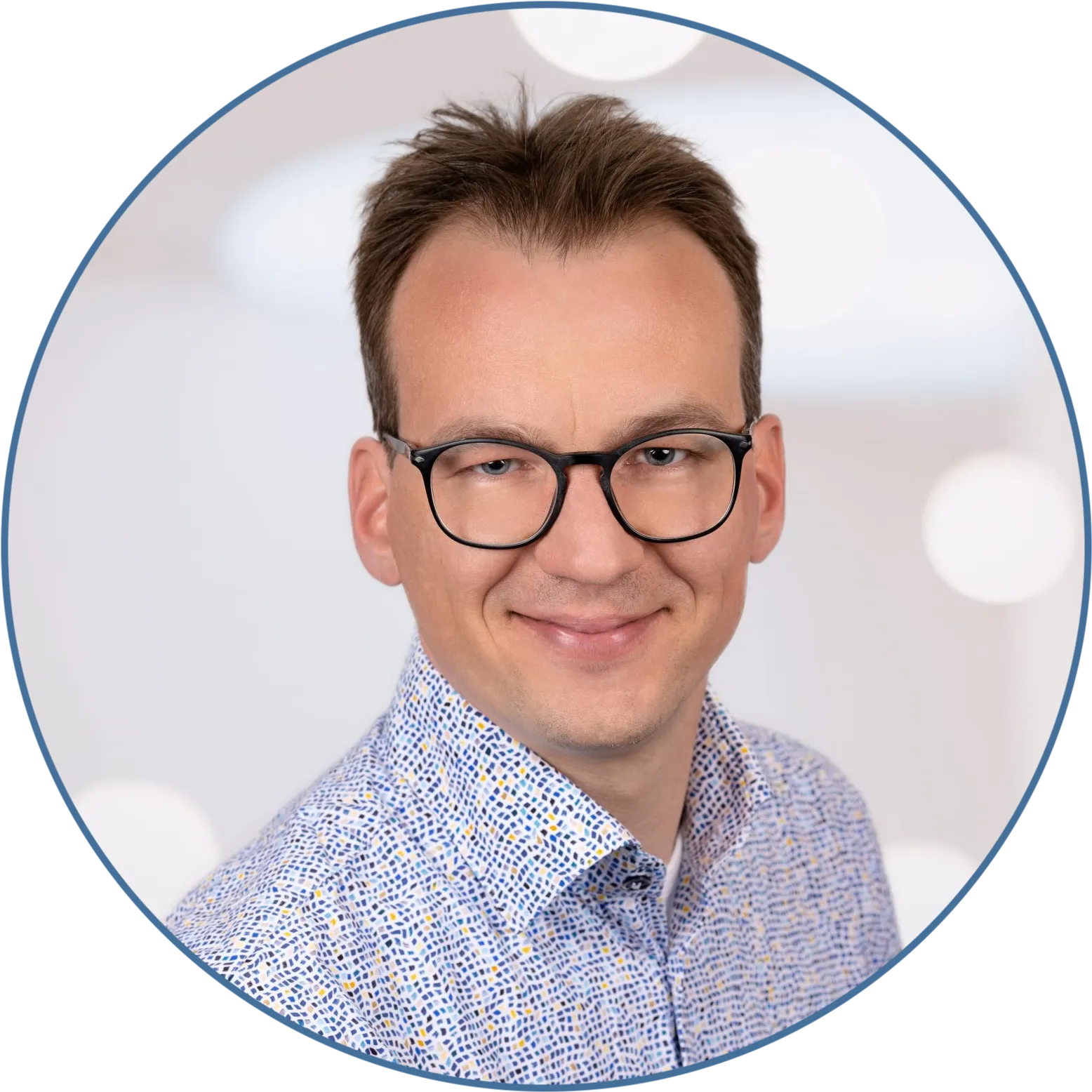
holds the chair of Journalism Studies at Vrije Universiteit Amsterdam, and is also affiliated with the Amsterdam School of Communication Research at the University of Amsterdam. He is an expert on computational social science and coordinator of the Horizon project TWON – Twin of Online Social Networks, which uses simulations involving LLM-powered agents to study the effect of platform mechanics on the quality of democratic debates.
E-mail: d.c.trilling@vu.nl · Website
Marko Grobelnik
is a researcher in the field of Artificial Intelligence (AI). Marko co-leads the Artificial Intelligence Lab at Jožef Stefan Institute, co-founded the UNESCO International Research Center on AI (IRCAI), and is the CEO of Quintelligence.com. Marko is co-author of several books, co-founder of several start-ups and is/was involved in over 100 EU-funded research projects in various fields of Artificial Intelligence. Significant organisational activities include Marko being general chair of the LREC2016 and TheWebConf2021 conferences. Marko represents Slovenia in the OECD AI Committee (AIGO/ONEAI), in the Council of Europe Committee on AI (CAHAI/CAI), NATO (DARB), and the Global Partnership on AI (GPAI). In 2016 Marko became Digital Champion of Slovenia at the European Commission.
E-mail: Marko.Grobelnik@ijs.si · Website
Cosima Pfannschmidt

is a scientific researcher at the Berlin branch of FZI Forschungszentrum Informatik and part of the House of Participation (HoP) since May 2024. She coordinates communication & dissemination activities in the project “TWON – Twin of Online Social Networks”. Her work focuses on translating scientific results into actionable policy recommendations and creating impact. Previously, she worked in the German Bundestag. She holds an M.A. in Sociology and a B.Sc. in Economics from Ludwig-Maximilians-Universität München.
E-mail: pfannschmidt@fzi.de · Website